A person living with bipolar disorder may spend a healthcare appointment describing how they feel that morning. Yet some of the most useful information about their health may lie in what happened over the preceding week: sleep became shorter, activity increased, and a familiar routine began to shift. If those changes never enter the conversation, the care team has an incomplete picture.
Wearables offer a practical way to bring more of that picture into psychiatric care. Used thoughtfully, information about sleep, activity, and other physiological patterns can help patients and clinicians understand what is changing and decide what deserves attention. The opportunity is to make care more responsive to the life a person is actually living.
For people with severe mental illness, that matters enormously. Recovery unfolds across ordinary days, through the work of rebuilding routines, relationships, and independence. Our ability to understand treatment response should reach into those days as well.
My commitment to this work began with my family’s experience navigating severe mental illness. Families often become the keepers of the story between appointments. They notice that someone is staying awake later, withdrawing from activities, or struggling with routines. They try to determine what those changes mean and when to call for help.
Those observations can be invaluable, but patients and families should have more support in making sense of them. A care team that can review patterns over time has another way to explore concerns before the next crisis defines the conversation.
Psychiatric assessment already draws on meaningful sources of information, including clinical interviews, patient-reported measures, and observations from trusted supporters. Wearable data can add a different perspective: repeated measurements gathered in daily life. It can help make a vague recollection more specific and reveal a trend that is difficult to reconstruct from memory.
This is particularly relevant to bipolar disorder, where changes in sleep, energy, and activity are part of the clinical picture, as the National Institute of Mental Health explains. A wearable cannot determine whether someone is developing a mood episode. It can give the clinician and patient a reason to look more closely together.
The most useful reference point is often the individual’s own pattern. What does sleep look like when this person feels well? How active are they when they are participating in the things that matter to them? How do those patterns change during a difficult period or after an adjustment in care?
Consider a hypothetical patient whose sleep gradually shortens over several nights. Reviewing that change alongside their report of increased energy could prompt a more focused assessment. The same sleep pattern in someone working a new overnight shift would call for a different conversation. The signal becomes useful through context.
That principle applies to improvement, too. A person recovering from depression might begin taking regular walks or keeping a more consistent sleep schedule. Discussing those changes can help connect treatment with progress the person recognizes in their own life, even when recovery still feels uneven.
This is an opportunity to make measurement more personal. A graph can support a conversation about getting to class, returning to work, or having enough energy to see friends. Patients should help define what progress means and whether the information reflects their experience. Their explanation remains essential to understanding the numbers.
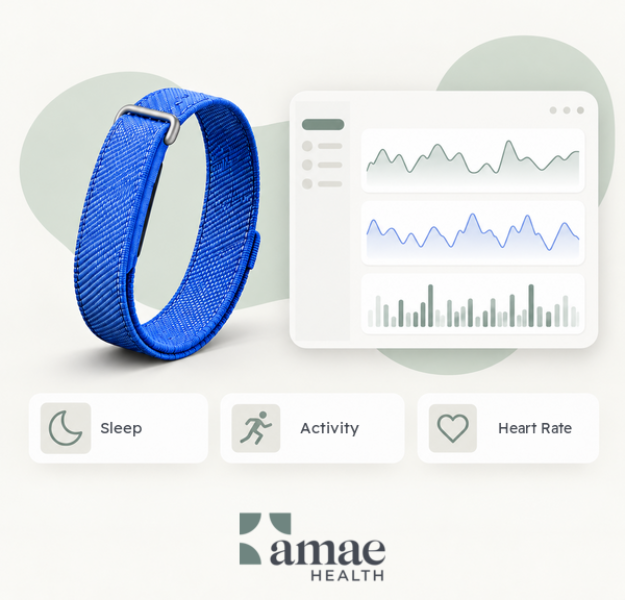
At Amae Health, our work with Google Health Enterprise has focused on bringing wearable-derived information into multidisciplinary psychiatric care. The collaboration incorporates sleep, activity, and heart rate variability data into clinical workflows, with patient consent. Published coverage describes the approach and its longer-term research ambitions.
The lesson for the field is practical: information needs to be available where clinicians already make decisions. A separate dashboard that requires another login and another search creates friction. A clear view within the clinical record makes it easier to discuss a pattern alongside symptoms, medications, and the treatment plan.
Our clinicians are now bringing this information into treatment conversations through our proprietary clinician platform. That experience has sharpened the question we should ask of any new technology: does it help the patient and care team understand something useful, and does that understanding inform care?
A psychiatrist may explore a change in sleep alongside medication response. A therapist may discuss how daily routines relate to mood. A health coach may help a patient work toward an activity goal. A shared view gives each professional relevant context while allowing the team to coordinate its response.
Making this work requires clear responsibility for reviewing information and following up. Patients also need to understand when review happens. Continuous data collection should never leave someone assuming that their team provides continuous monitoring.
Wearable information may be especially helpful as treatment becomes less intensive. A person stepping down from frequent programming is also rebuilding a life outside the clinic. The team has fewer opportunities to observe daily functioning just as work, school, and other responsibilities begin to occupy more time.
With the patient’s agreement, reviewing sleep and activity patterns could help maintain a useful connection during that transition. A change might prompt the team to ask about a new schedule, a treatment concern, or a need for additional support. A steady pattern could provide context for discussing how the transition is going.
This fits a broader goal for severe mental illness care: sustained support as needs evolve. A device contributes most when a team knows the person, understands their history, and can help them access appropriate care. That relationship gives observations somewhere to go.
Trust also determines whether participation is useful. Patients deserve a clear explanation of what is collected and how it will be used, practical help using the device, and the freedom to decline. When a tool feels burdensome or distressing, the care plan should adapt. Participation should support a person’s agency and confidence in their care.
The prospect of identifying deterioration earlier is compelling. Being able to recognize a concerning pattern and offer support before a person loses stability would be a meaningful advance. That ambition should guide research without getting ahead of what has been demonstrated.
Using wearable information to enrich a clinical conversation is different from validating a model that predicts relapse. Predictive tools must show that they identify clinically meaningful changes reliably, with enough time for a useful response. Researchers must also examine false alerts, missed events, and performance across different patient populations.
For now, organizations can evaluate whether these tools improve the process of care. Does reviewing a trend lead to a useful assessment? Does it help a patient describe a concern or understand progress? Can clinicians incorporate it without adding work that crowds out time with patients? These questions deserve answers alongside longer-term studies of symptoms, functioning, and hospital use.
As the evidence develops, combining wearable signals with other clinical information may offer a richer understanding of treatment response. Any broader measure of mental health will need to account for how much recovery varies across people and circumstances.
For someone living with severe mental illness, better care may mean recognizing a difficult change sooner. It may also mean understanding why mornings feel easier, seeing a routine become sustainable, or feeling more confident about returning to school.
Wearables can help bring those everyday experiences into the treatment conversation. Their contribution will depend on whether we connect measurement to thoughtful clinical judgment and a team able to respond. That is the work that can make more continuous information meaningful in people’s lives.