.png)

In 1948, a group of people leaving state psychiatric institutions made a radical observation: the medical model alone was not working for them. They needed community. They needed purpose. They needed one another.
So they started meeting on the steps of the New York Public Library. They called themselves WANA, short for We Are Not Alone. That small gathering eventually became Fountain House, the originator of the Clubhouse model, a psychosocial rehabilitation approach that now spans 380 Clubhouses in 33 countries and serves 100,000 people living with serious mental illness.
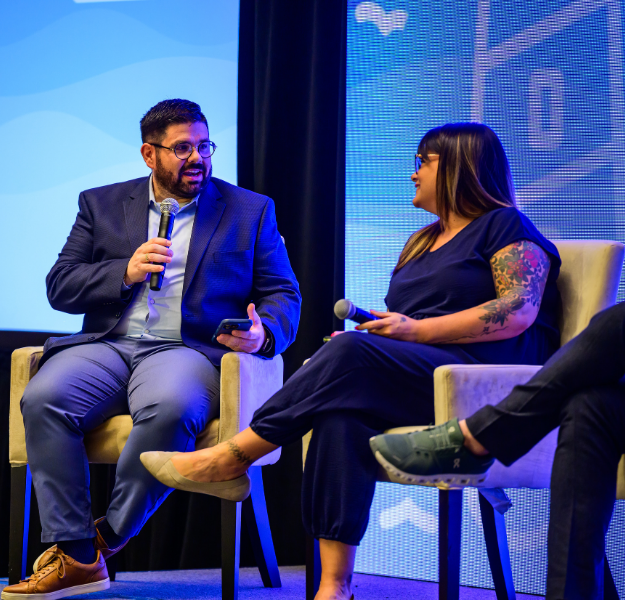
Josh Seidman, Chief External Impact Officer at Fountain House, joined the Expanding Access podcast to talk about what makes the Clubhouse model work, how data is being used to prove and improve its impact, and why he believes the healthcare system suffers from a fundamental lack of imagination when it comes to mental health.
The Clubhouse model looks different from most behavioral health programs from the moment someone walks through the door. People who come to a Clubhouse are not called patients or clients. They are members, and that distinction is not just semantic.
Membership is voluntary. The work of the Clubhouse is done in genuine partnership between staff and members. There are no clinical hierarchies structuring who holds power and who receives care. Instead, members contribute to the daily operations of the community, through what the model calls the "work-ordered day," helping with everything from meal preparation to outreach to administrative tasks.
“Everything at Fountain House is a co-leadership model, and that includes how we do research.”
Fountain House itself operates four Clubhouses, including its original flagship location in Hell’s Kitchen in New York City, a location in the South Bronx, a newer site in central Harlem, and a Clubhouse in Hollywood, California, which was launched just over a year ago at the request of the LA County Department of Mental Health. Mayor Bass visited the Hollywood location just weeks before this conversation was recorded. Beyond those four sites, the broader Clubhouse International network includes 380 accredited locations across 33 countries.
Seidman spent more than 30 years working in health services research and policy in Washington, DC. He holds a PhD in health services research and has done extensive work in human-centered design, spending years following patients through their clinical experiences and observing care delivery in hospitals and clinics.
Over time, he came to a conclusion that many in the policy world resist: focusing almost entirely on the clinical side of care was not enough to actually improve health.
“After 30-plus years of focus on how can we improve healthcare, I felt like I wasn’t doing enough to improve health. Fountain House figured out decades ago that we need to be addressing those social drivers of health and psychosocial needs.”
He also points to something he calls a lack of imagination inside Washington. The tendency, he says, is to assume that if something has not been done it cannot be done, when the reality is often the reverse. Fountain House, with its long history and global reach, represented something rare: a community that never stopped imagining something better.
His personal experience also played a role. Family members with serious mental illness made this work deeply personal, and he decided to direct whatever skills he had toward trying to fix what he describes plainly as a broken mental health system.
The Clubhouse model is not just a feel-good community program. It is backed by a growing body of evidence. Seidman walked through several key findings when asked about the research base.
Members of Clubhouses have higher rates of employment and more successful housing outcomes than comparable populations. Roughly 35 to 40 percent of people who come to Fountain House have some history of homelessness. Fountain House itself operates 400 units of supportive housing as part of its broader mission.
One of the most striking outcomes is related to loneliness. Using the validated UCLA 3-Item Loneliness Scale, Fountain House found that 73 percent of incoming members present with high levels of loneliness. At a 12 to 18 month follow-up, 58 percent of those members had experienced a meaningful reduction in loneliness. Given what is now known about the health consequences of social isolation, that outcome matters well beyond quality of life.
“The Surgeon General talked about how loneliness is comparable to smoking 15 cigarettes a day. So we are having a big impact on something that makes a huge difference in people’s lives.”
On the cost side, an NYU study found that compared to a comparable high-risk population living with serious mental illness, Clubhouse members generated 21 percent lower Medicaid costs. When broader societal costs are included, such as disability, criminal justice involvement, and lost wages, Clubhouses save society more than $11,000 per member per year.
One of the more unusual aspects of how Fountain House approaches research is who gets to set the agenda. Rather than designing studies around what is easy to measure or what funders traditionally want to see, Fountain House has invested deeply in community-based participatory action research, a model in which members are partners in the research process, not subjects of it.
Members receive training in research methods. They conduct focus groups, code interviews, and in some cases carry out quantitative analysis. They help determine what questions are worth asking in the first place.
That philosophy animated a major new project called Measures That Matter, funded by four foundations and just being released at the time of this recording. The project set out to answer a deceptively simple question: what do people with lived experience of serious mental illness actually care about when it comes to measuring their own wellbeing and recovery?
The process involved 20 working groups, four focus groups with both Clubhouse members and people with serious mental illness who were not affiliated with Clubhouses, and a survey with nearly 100 responses. The result is a framework for outcomes measurement grounded in what actually matters to the people being served, rather than what is convenient for the systems serving them.
“Historically in behavioral health we kind of measure what’s easy to measure rather than measuring what really matters.”
The research ambitions at Fountain House extend well beyond its own four Clubhouses. About four years ago, the organization began building what is now called the Fountain House United Research Network, or FHURN, a data sharing network that currently includes 21 Clubhouses across 11 states.
The challenge in building this network was significant. Many Clubhouses are small community-based organizations with limited history of formal data collection or reporting. Before any data could be shared, Fountain House invested heavily in building capacity, training staff and members at partner organizations in data and research methods.
The platform that has been built allows participating Clubhouses to collect a common set of data elements and share that data across the network. The goals are layered. At one level, it is a quality improvement tool. Clubhouses can compare their outcomes against peers, identify areas for growth, and share best practices with one another. If one Clubhouse is seeing exceptional employment outcomes, others can learn how.
At another level, FHURN is designed to be a learning health system, a dynamic infrastructure for collaborative research and evidence generation that can advance the understanding of how to best support people with serious mental illness over time.
There is also an accountability dimension. In New York City, a new Clubhouse contract that took effect about a year ago now requires Clubhouses to report on employment, education, hospitalization rates, emergency room utilization, and member-reported outcomes including quality of life, loneliness, and self-efficacy. Seidman expects that as a data baseline develops, it will increasingly be used for performance assessment.
“We absolutely believe that we need to be moving towards more value-based payment systems, and it is critically important that value in those systems be judged by things that really matter to the people being served.”
For anyone who wants to learn more or find a Clubhouse in their community, Seidman points to two resources. Fountain House’s own website, fountainhouse.org, houses research, white papers, and information about the model. For finding a specific location, the Clubhouse International website maintains a searchable directory of all accredited Clubhouses, organized by state and country.
Clubhouse International is an independent accrediting organization that spun off from Fountain House more than 30 years ago. It accredits Clubhouses against a set of 37 standards that are themselves shaped through a collaborative process involving both staff and members. Accreditation is renewed every three years.
Asked how those in positions of influence can support the Clubhouse movement, Seidman is direct: more investment is needed. He notes that New York City, New York State, and California have all recently made meaningful commitments to expanding Clubhouse access. But demand far exceeds what currently exists.
For payers specifically, the data make a compelling case. A 21 percent reduction in Medicaid costs, better housing outcomes, lower rates of hospitalization and emergency room use: these are outcomes that managed care plans should care about. The challenge is that Clubhouses operate outside traditional clinical frameworks, which can make contracting and reimbursement complicated.
Seidman’s broader message to the healthcare system is one that Fountain House has been embodying for more than 75 years: stop underestimating what people with serious mental illness are capable of when they are given real community, real purpose, and real partnership.
“Nobody at Fountain House ever suffers from a lack of imagination. And it has been a really wonderful experience to be part of a community that really strives to improve the lives of people with serious mental illness throughout the country.”
What started on the steps of the New York Public Library, built by people who refused to accept that institutions were the only answer, has grown into a global movement with the data to prove it works. The question now, as Seidman sees it, is whether the healthcare system has the imagination to meet it.
To learn more about Fountain House, visit fountainhouse.org. To find a Clubhouse near you, visit clubhouse-intl.org. For more episodes of the Expanding Access podcast, visit behavioralhealthtech.com/podcast.





.png)