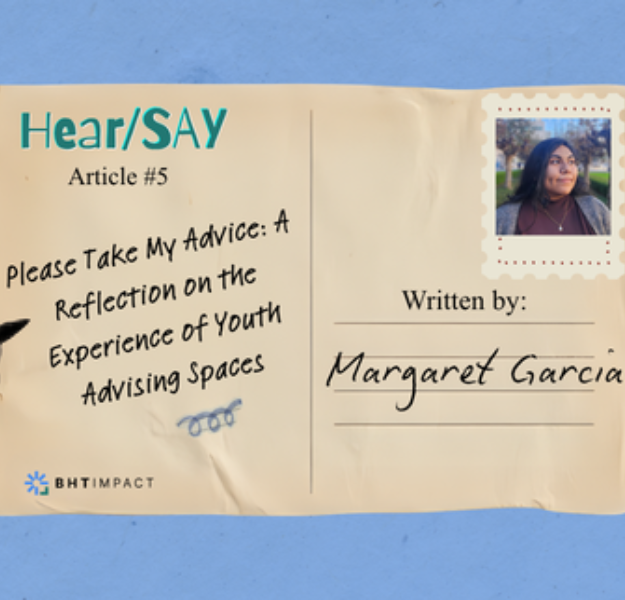
"Please Take My Advice: A Reflection on the Experience of Youth Advising Spaces" on a postcard.

Hear/SAY Creator’s Contributor Margaret Garcia reflects on what happens when young people share their ideas, insights, and expertise, only to see little evidence that their contributions shaped the work they were asked to inform. This piece offers an honest look at the frustrations, opportunities, and responsibilities that come with engaging youth as collaborators.

“ I think my idea really reflects what we should change in order to address more youth issues.”
“Great, thank you, we will take it into consideration.”

The same phrases have been repeated to me for the past few years in this space, and it is met with the continued dismissal of my peers’ and my perspectives. They take the advice, say it will be considered, then never take steps to include or consult further. These leaders still wonder why they can not reach their target audience when they fail to absorb input from the target audience themselves.

This is a frustrating cycle I have encountered in many of the youth advising mental health spaces I have been in. As a result, I began to ask myself, “What value does my lived experiences and insight have when I can’t utilize it to support my peers?” What is the purpose of serving as an advisor or co-creator for youth- and young adult-targeted projects when my advice isn't taken? I dwell on this conflict at times and fear that these positions are not fully genuine for some “youth serving” organizations. However, there are some that truly do care, and I do not lose all hope.

What does it take to truly be in a youth partnership, and how can organizations improve their collaboration? I believe it is the following:

  1. Providing an understandable framework for how we can support the project at hand.
    • I have come to understand that some organizations seek a specific kind of insight that isn't properly translated to youth/young adult advising. This creates a barrier to understanding what is being asked of advisors and, subsequently, what is published to the public. These organizations need to provide a simplified outline when seeking specific insight; that way, the information provided by youth can be truly utilized.
      For example, while advising on mental health campaigns for youth, we were asked to simply “see if anything catches your attention.” This vague instruction ultimately led us to mark spelling mistakes rather than what was truly being sought: a genuine, translatable perspective on how to make the material more reflective of youth concerns. The resulting material did not resonate well, and we ultimately needed to spend even more time re-reviewing it. These organizations should remember that for many, this is the first place where youth are told their opinions actually matter and can make a difference. We just need a bit more guidance on how to share it properly.
  2. Showcasing genuine interest:
    • Youth and young adults are asked to provide our insight, labor, and time for projects we are passionate about. When engaging in these projects, it often feels like a mission, plan, or intention already exists and was never meant to include our opinions. That is visible when we are in the co-design space, and it can be discouraging. At times, it is so visible that the belief starts to grow that this “youth insight” was merely for show. Please be encouraging, please see youths’ hopes to create in tandem with your organization, and please be mindful that even though they are younger, they can still see when they might not be truthfully invited.
  3. Assign meaningful work:
    • Some organizations seem at times too fearful to fully involve youth/young adults in projects they claim to be youth/young adult-advised and created. For some, they assigned us to post on social media about the projects we would be involved with, when youth/young adults were not invited to co-create them in the beginning. I implore organizations to realize that we signed on for these projects because we are genuinely interested in being involved. We want to do more than post a hashtag on social media, and we want to actively improve the lives of our peers around us. Was that not the goal of co-design? To gain our insight and utilize it to improve the outcomes of youth? I plead with these organizations to remember that, and trust that the youth they selected to support in learning what their peers need.

Youth/young adult partnerships should encourage discussion, foster a sense that we are creating meaningful impact, and ensure that ideas are not just up for consideration, but can be built upon, expanded, and explored further.

One particular advisory position I value is my work under Together for Wellness, a mental health project under the state of California’s Children and Youth Behavioral Health Initiative. Here, organizers actively included us advisors at every step of the way and placed their trust in us to create a successful project. In doing so, we are more invigorated to participate and feel as though our opinions are heard and incorporated.  For example, last year we organized our 2nd annual Youth Mental Health Summit, where we presented our ideas on what our youth peers would like to see, aided in designing marketing materials, conducted recruitment efforts, and reached out to collaborators on our own. All of this was done with the support from our organizers, who trusted that we would know what our peers would like to see.

Placing their trust in us gave us motivation to engage more, as it was a truly collaborative experience that made us feel it was our project too. We wanted to see it succeed just as much, if not more so, because we dedicated time and effort that we could not have done if we weren’t given a stake in the project.  I truly believe making youth advisors feel as though it is their project as well, would make the project more successful than without.

I hope future co-designing and advising youth/young adults will achieve their goals within these organizations and more as I begin to age out of this demographic.