.png)
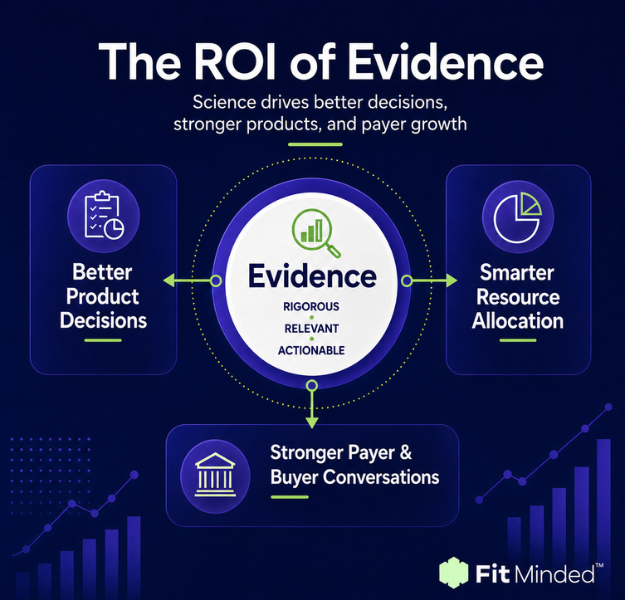
Most behavioral health and digital health founders think about evidence the same way: it's something you generate to prove your product works, whether that's a stat for the pitch deck or a line in a press release.
That framing isn't wrong, but it's incomplete, and it's costing founders more than they realize.
In my experience, evidence isn't just proof after the fact. It's a decision-making tool that touches nearly every part of the business, long before you're ready to publish anything. The companies getting real return on their evidence investment aren't the ones with the most polished outcomes study. They're the ones who define the business question the evidence will answer before launching the study. Subsequently, they can use their data to make better calls, earlier, and across product, resourcing, and growth. This article unpacks what that looks like in practice.
Founders often treat evidence generation as something that happens once a product is built and stable: collect the data, run the analysis, publish the result. That sequencing feels safe; however, it also means the evidence shows up too late to change anything. By the time your study is complete, the product decisions it might have informed are probably already made (let’s face it, startups have to move quickly). Worse, you may have burnt time chasing the wrong questions, or trying to address questions your data was never equipped to answer.
Flip the order, and evidence becomes a filter you run early decisions through instead of a stamp you put on late ones. Most companies already have the raw material sitting in product analytics, customer support logs, and onboarding funnels. What's usually missing isn't the data, it's someone asking specific questions of it before the roadmap gets set for the next quarter.
Questions like: which of our current features actually correlates with a user staying past week four, versus one that just gets used a lot in week one? Where in the funnel do users who eventually convert behave differently than users who churn, and how early does that difference show up?
Those are answerable this month with data you already have, not a study you'd need six months to run. But answering them well takes a behavioral scientist's eye, not just a data scientist's. The harder part isn't running the query, it's knowing which behavioral pattern to look for in the first place.
That’s an incredible early win: a product team that stops guessing, long before anyone's ready to publish a thing.
I've worked with companies from pre-seed through Series D across behavioral health, femtech, and AI-driven wellness platforms, and have identified a pretty consistent pattern: the founders who are struggling most in investor and payer conversations aren't lacking passion or vision. They're lacking a clear story about what their existing data actually shows.
This matters because "evidence" doesn't mean a randomized controlled trial (aka, an RCT). At the earliest stages, it means something much more accessible: retention curves broken out by user segment, engagement patterns tied to specific features, qualitative signals from support tickets or user interviews that explain the why behind the numbers. None of this needs an RCT or a six-figure budget. Just someone asking the right question of the data that already exists.
When that analysis gets done well, it changes three conversations at once.
A founder once told me he thought science had diminishing returns for a company. He was wrong. Evidence compounds. Skip it early, and you're not avoiding the cost. You're deferring it, with interest.
That cost shows up in ordinary ways, not just in a missed study, but in decisions made without a five-minute look at data you already had. Here's one version, something you've likely seen firsthand, or heard about if you've spent time in this space: a product team builds out a new feature because a vocal subset of users keeps requesting it in support tickets and app store reviews. The feature ships. Engagement on it looks fine for a few weeks. Only later, when someone finally pulls retention data by user segment, does it become clear that the vocal group was never the group driving revenue or renewal in the first place, and the quieter majority who actually stuck around wanted something else entirely. Nobody looked at the data before the feature shipped.
That same mistake shows up in different forms: budget allocated evenly across a funnel instead of toward the leak that's actually draining it, or a payer conversation built on anecdotes instead of numbers that stalls exactly where it should have accelerated. In each case, the evidence was already there, it just hadn't been reviewed before the decision got made.
For founders wondering where to start, three intentional shifts cover most of the ground.
First, treat your existing data as a decision-making asset rather than just a reporting requirement. Most companies already have the raw material: usage logs, retention data, support interactions, onboarding funnels. The real question isn't whether you have data. It's whether anyone is analyzing it early enough to shape a business decision, not just explain it after the fact.
Second, before deciding what feature ships, where the budget gets allocated, or whether a claim goes into a pitch deck, ask what specific data point would justify that call. That forces you to identify, in advance, what evidence would actually move a decision, which makes it much easier to notice when you already have that evidence sitting in a spreadsheet somewhere.
Third, translate findings into the language of the audience you're speaking to. A retention curve means one thing to a product team, another thing to an investor, and something different again to a payer evaluating cost offset. The underlying analysis doesn't change. Only the framing does, and that's the difference between data that sits in a deck and data that closes a conversation.
A quick gut check for where you stand right now: Can you name the two or three user behaviors most correlated with retention in your product? Could you explain, with a number rather than a story, why a payer or health system should trust your outcomes? If a founder can't answer either of those without pulling new data first, that's usually a sign the evidence already exists in your usage logs and support data, it just hasn't been analyzed yet.
Investors are running deeper diligence before writing a check. Payers want more than a good pilot story before they'll expand a contract. Enterprise buyers need a business case, not a demo, before they'll sign. Founders who treat evidence as something to produce once, for one audience, at one point in the fundraising cycle, are going to find themselves re-explaining their value proposition from scratch every time the audience changes.
Founders who treat evidence as an ongoing decision-making practice won't have that problem, because their product roadmap, their resourcing decisions, and their pitch are already telling the same story. All of it draws from the same underlying discipline: look at what the data actually shows before you decide what to do about it.
That shift, from evidence as a finish line to evidence as a filter, is one of the highest-return habits a founder in this space can build. It doesn't require a research team. It requires a willingness to look at what you already have before adding to it.





.png)